
Where's Your Mama Gone?
Mothering the self with PJ Harvey

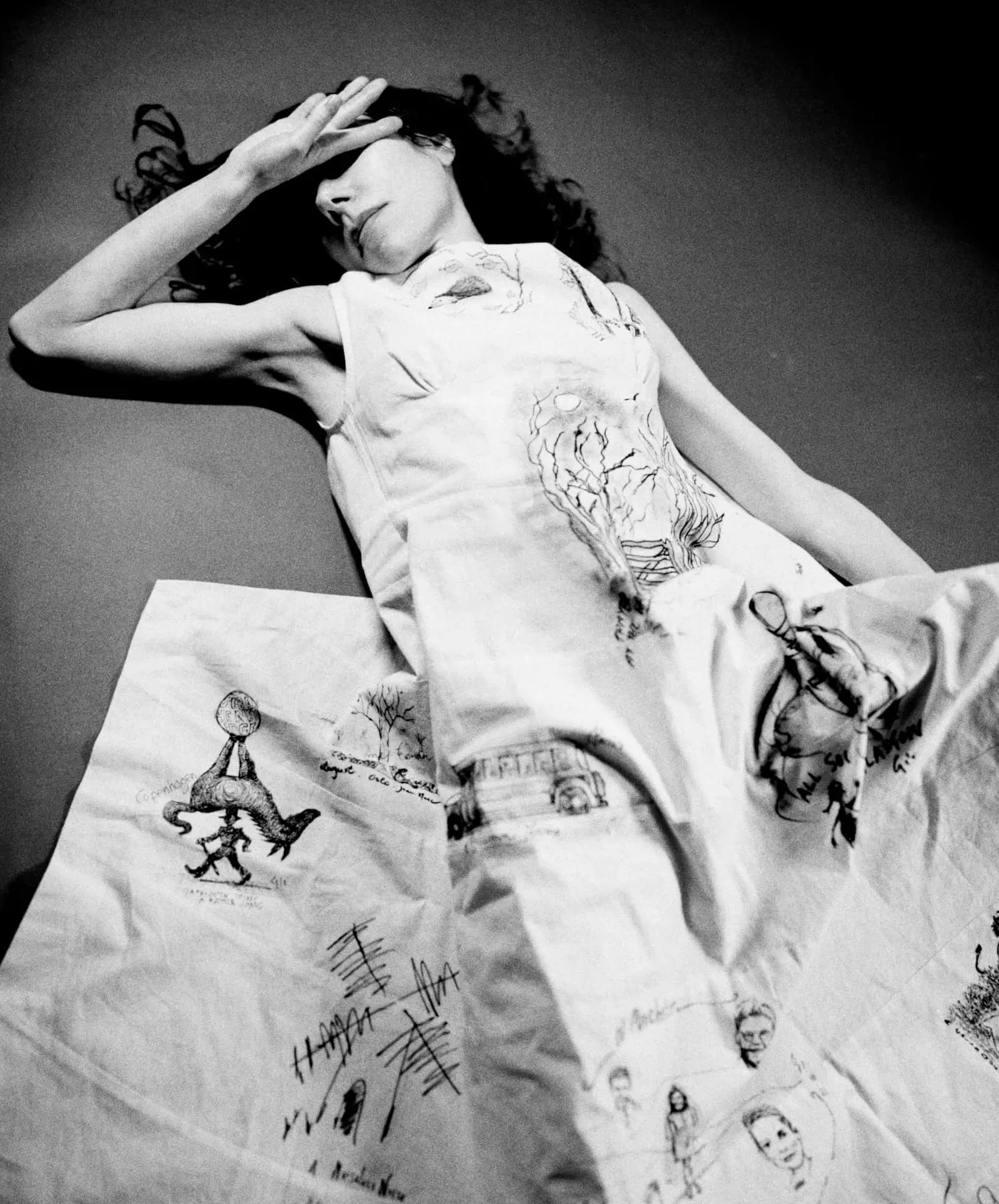
Mothers and children are abundant in the work of PJ Harvey. But these ghostly figures—in my reading of Harvey’s work, at least—are not merely mothers and their children or children and their mothers, but children who mother themselves and, necessarily, mothers who themselves are children. My interpretation is perhaps nothing to do with the artist herself and possibly everything to do with me, but I like to think Harvey intended mine to be one of many possible readings of her vast and differentiated body of work.1 Art is never solely autobiographical, nor is it only a reflection of the listener, viewer, reader. It’s an active engaging of and by both parties, artist and audience. And lately, my “engagements” with Polly have been multi-layered ones wholly evocative of the maternal. Polly Jean Harvey has done it, she’s had me thinking of my mother and, indeed, myself the mother.
“Nina in Ecstasy” is where I should start. Although never released (Harvey released a demo version of the song in her 2022 collection, B-Sides, Demos & Rarities), the song has been praised by Harvey’s collaborators and fans as among her very best.2 Not to deal too heavily in the idiom of the modern music critic (before proceeding to do so…), but “Nina” is a bird’s wing of a song: Just Harvey and what I think is a synth pad; her words sung in short, staccato fragments, like breaths cut short (“I feel love / I’ll be safe / I’ll be yours / I’ll be safe…”, reassurances sung waveringly); Polly’s voice at or near its highest register. “Where’s your mama gone?” is the refrain (repurposed from a much peppier Middle of the Road song): At once the lament of a concerned Greek chorus and perhaps also a prayer of the titular Nina, it’s clear the protagonist is alone.
I’ll abstain from making this piece an experiment in self-pity, for the reader’s sake and my own, so let me just say my mother is absent. This apparently offhand caveat, of course, belies an agglomeration of pain, and has done for all of history and myth (cf. Hagar and Jezebel, Clytemnestra and Medea), and that is entirely the point. The point of departure for some of the most powerful works of art is the absent or errant mother. “Where’s your mama gone?” Nina’s admonishing herself: The pain inflicted upon one by the parent is shamefully turned inward. (I suppose I’m projecting myself onto Harvey’s song.) I imagine Nina facing a great void—one as cavernous as a womb—and steeling herself to sit in her pain and confront the uncertainty and irresoluteness of a life to be lived without a maternal source of guidance and care. A mother, if she’s no longer around, can become a ghostly presence, making one unsure if she was ever there in the first place, a flickering light in the recesses of the brain which never vanishes but never fully illuminates, either.
Not coincidentally, the hours I’ve spent with “Nina in Ecstasy” have moved me to seek out Ingmar Bergman’s Cries and Whispers, a film I’ve seen before but never could place into any understandable framework.3 In the film (which features vivid red sets, as in a womb), a character called Agnes lies on her deathbed and dreams of her late, unyielding mother, who clearly favored Agnes’s sister and frequently conveyed disappointment in Agnes. But alas, as Agnes stares into the void on the other side of the veil, she’s reminded of her life and inevitably, the one who gave life unto her. “Where’s your mama gone?” could very well be Agnes’s refrain, too.
Unlike Agnes, what I’m facing now is not (yet) my earthly demise, but the death of a prior self. I’ve catalogued such an immense cascade of changes in my personal life over the past half-year that I feel as if that prior iteration of myself, the self who lived my old life, must be dead and buried. And maybe that likens me to Nina, who “grew older,” “cold,” and “lost her way,” whose inner child simply died. “Where’s your mama gone?” And who do we think of in death but our mothers? The thought that I might have better-weathered the recent tumult of my life under a mother’s protection, someone to assure me I’m good, has frequently crossed my mind. Without one, it feels like I’m staring into a motherless—Godless—void, just as I imagine Nina to be. But I have something Nina doesn’t, and that’s the music of Polly Jean Harvey.4 Through my listening, I’ve come to realize that my void is, in fact, occupied by a presence, one I’ve deduced is actually myself.
Who else brought me to this realization but Joy, the girl who lives a Southern Gothic life in a Blakean lyric in the world wrought by PJ Harvey on her fourth album, Is This Desire?. In Joy’s void, she confronts the horror of facing who she is or, more precisely, who she never was. “I’ve been believing in nothing since I was born—it never was a question!” I think the nothing, no-thing, that obsesses Joy is the very void she believes herself to be: “She looked away into a hollow sky” and “came face-to-face with her own innocence surrounding her.” Where’s your mama gone, Joy? Even if Joy does indeed have a living mother, a prim, bird-like Southern Gothic matron, Joy hasn’t become a mother to herself. She hasn’t embraced her inner child, she hasn’t attempted to nurture her inner child into the woman she is now. She’s stuck.
Jung (jump scare) once spoke of a girl never fully born, who existed in a liminal space between worlds, a bardo. She maintained the innocence of a child newly sprung yet was marked by the experience of the corporeal world. A psychoanalyst called Wilfred Bion (Samuel Beckett was his patient), inspired by Jung, compared the unborn girl to the psychoanalytic situation: On the couch is a person waiting—struggling, if they’re doing it right—to be born. In this way, we perhaps “give birth” to the selves we want to be. The image that comes to mind is that of a Russian nesting doll: Our outer, performative self giving way to an inner, inevitable core. Or perhaps the rings of a tree, to account for the element of time: The older, outer rings cloaking the pith that is our first year. We’re continuously birthing and dying, our youngest selves remaining inside for us to nurture, yes, but also to renew. We must move forward, incorporating our oldest, most primitive parts, to become whole individuals.
As mothers to ourselves, we can be derelict or downright foul—this is what we must be wary of. In PJ Harvey’s “Down By the Water,” the narrator tells us it was the water where she “took her hand / my lovely daughter / won’t see her again.” On its face, the song is a murder ballad: A mother drowns her unchaste daughter and now, with the “blue-eyed whore” dead, the “lovely daughter” is the one she’ll remember. But lately I can’t shake a more self-reflexive reading of the song, that is, of a woman whose own innocence was lost “under the bridge,” by her own hand. Slipping her former self under the water, the woman “had to lose her / to do her harm.” This amounts to renouncing—rather than nurturing—the former self.
As mothers to ourselves, we can also be sanguine. “White Chalk” and “When Under Ether,” two songs from Harvey’s 2007 album of which the former song is the title track, deal with the unborn, the selves we might or might not have become. Our life changes—we move away from a place, we part ways with a lover—and suddenly the self we could’ve been in that iteration of our life departs. When Harvey’s narrator sings of, “Dorset’s cliffs…where I walked / our unborn child in me,” the unborn self is made conditional upon a particular place and time with a particular person. On “When Under Ether,” when I hear the thing “inside me / unborn and unblessed… disappears in the ether / this world to the next,” I hear words of sorrow tinged with possibility. The song ends as a eulogy: “Human kindness.” In a moment of vulnerability (a loss of the self), to be treated with kindness and to treat yourself with kindness seems to be the first step toward renewal.
I think Polly’s latest album, I Inside the Old Year Dying, shows us what mothering ourselves could look like—through not just the songs on the album, but also the very act of releasing it. Harvey, speaking to Amanda Petrusich, said the album’s title is intended to evoke the “transformation of both person and year into something else.” This is the album when Harvey’s unborn children who mother are loosed on the world. The song perhaps most evocative of self-transformation is the appropriately titled, “I Inside the Old I Dying,” in which she sings, “Slip from my childhood skin…” Her narrator’s child self is among the “chalky children” (ghost children) who haunt the album. If this is Harvey’s peacemaking with her youth, if only partly so, then it’s very clearly not an abandoning of it, it’s an embrace of it: Her child self will remain with her. As she sings in “Prayer at the Gate,” “all souls…made passage for the born again.” Her self unborn on White Chalk has finally been birthed.
1 Perhaps “intended” is too angular a word. I’ve come to experience Harvey’s work as quite a capacious thing, teeming with ambiguity and paradoxical tensions which invite us to bear witness to an idea and its opposite. It’s this capaciousness that appears to be of Harvey’s design, an achievement considering her aesthetic minimalism.
2 John Parish, who has been collaborating with Harvey for about forty years (since a determined young Harvey joined his band, of which she was a fan), said this about the song to The Quietus: “I think [‘Nina in Ecstasy’] is one of Polly’s best songs. . .I can see it was pointing to where she was going to end up, using that high, fragile voice that she’d deliberately not considered using until that time—everything had been quite powerful and confident and in control. That was the first time she’d sounded vulnerable on a record—you have to have confidence to open up like that.” Rolling Stone also included the song on a list of Harvey’s best deep cuts, a list titled, “15 Insanely Great PJ Harvey Songs Only Hardcore Fans Know (And Everyone Else Should Too).”
3 Harvey’s music is cinematic. The visuals created through her songs are not just visions themselves but appear to be visually inspired: The artist has cited filmmakers such as Steve McQueen, Jonathan Glazer, Paul Thomas Anderson, Céline Sciamma, Joanna Hogg, and Stanley Kubrick as influences. These are rather unusual citations for a musician to make, but entirely not surprising to someone who has hallucinated ecstatically while listening to a PJ Harvey album.
4 In the PJ Harvey extended musical universe, does the presence of Polly herself haunt the lives of Joe, Elise, Nina, Ira-Abel, and Mr. Badmouth himself, the characters who wander her works?
Chirpy Chirpy Cheep Cheep. An all time favorite.