
The Money Shot
On Maria Mochnacz's photographs of PJ Harvey

When I hear music, I see images. Patti Smith’s “Birdland” exists in a desolate, arctic landscape; Bartók’s folk dances bring forth a dusty bazaar where, around every corner, lurks the Winkie’s Diner bum; and X’s Los Angeles album is the Vegas strip viewed through a zoetrope. Maybe this peculiar tendency of mine is why I gravitate to the work of PJ Harvey, an artist whose music is so much more than just sound. Harvey describes her writing process as fundamentally visual: If a composition “is moving into song, it’ll have color or a shape,” she says, and “once…recorded, the songs present their own visuals.” Most know Harvey for her music, but I find it rather odd to think of her as simply a musician, precisely because her music is so sculptural.¹ Seemingly, her songs are thin lines which she diligently pinches and pulls at to form elegant, emotional arcs, evincing her command of space, audience, listener, and, importantly, the presentation of her work. Harvey’s visuals aren’t accompaniments to her music; they’re symbiotic with it, acting on us and altering our response to what we hear.
Some of the most intriguing images of PJ Harvey have been made by Maria Mochnacz, an artist who works in photography and has been capturing Harvey on film for decades. “I first met Polly Harvey in the late 1980s when she joined Automatic Dlamini,” says Mochnacz. Their collaboration began before either had achieved major success: Harvey, who was just beginning her music career with the PJ Harvey Trio (alongside musicians Rob Ellis and Steve Vaughan), approached Mochnacz because “[w]e need some photographs” and Mochnacz was her “only friend…who had a camera”. Mochnacz, not having “done anything like that” before, accepted with a shrug (“‘I’ll have a go’”). This casual act epitomizes so much of Harvey’s career: Regardless of the immense acclaim she receives, her work remains exactly that, a labor, one which she and a small circle of trusted collaborators devote deep care to.
Yet Harvey was aware of the commercial imperatives imposed by the music industry from the very beginning. (“We need some photographs.”) To make a career out of music, one must not just make the music but also sell it, reluctantly or not. Mochnacz understands this reality as a fundamental aspect of her work with Harvey and, as such, has endeavored to create photographs that both are reflexive about their function—at least in some quarters—to “sell” the music and, most importantly, grant autonomy to the musician over how she and her body of work are perceived. Mochnacz’s photos of Harvey engage in a critique of commercialism, not condemning the marketization of Harvey’s music per se but knowingly winking at it, letting it be known that the pair are every bit self-aware of what they’re doing and how you, the onlooker, are perceiving it. (My friend Ngaire Ruth, a feminist music critic who gave Harvey her first review and interview, writes brilliantly about these subjects on her own Substack, Taking Control.)
~
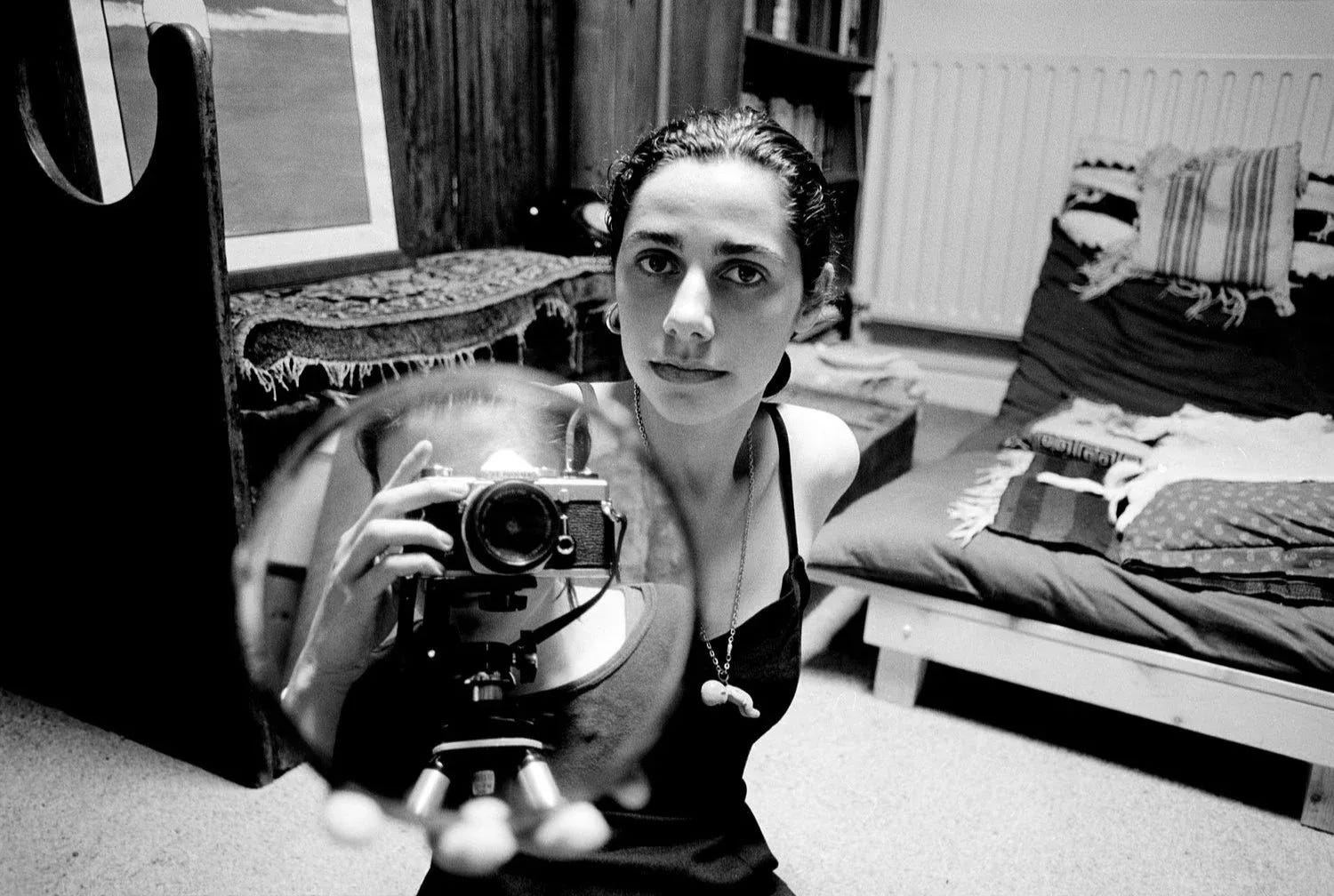
Image No. 1: The Photographer in the Glass (see cover photo)
The author of the photo reveals herself, capturing her reflection in a mirror held up by her subject. This is the photographic equivalent of the characters in Breathless looking at Godard’s camera, Henry Hill walking the audience through his criminal exploits in Goodfellas. In film, these moments shock because they confront cinematic audiences with their own voyeuristic gaze. We, the viewers of these photos, are just as (implicitly) indicted. In 1991, Harvey was only 22 years old (she wears a baby on a chain) and about to face scrutiny from the English music press over her topless NME cover. (It’s a beautiful image and, FFS, her back is turned!)
Beyond the voyeurism, though, the photo gives insight into the tender and hand-hewn reality of Harvey’s ascent. The person behind the camera, Mochnacz, is a trusted friend; you can tell in the way Harvey appears in all of Mochnacz’s photos, that is, unguarded and willing to participate—play, even—as fully herself. One sees that the photographer herself is a young woman, Polly’s peer, rather than someone much older or male, which would alter the power dynamic. The two friends are ostensibly sitting in someone’s home in Dorset, not some impersonal, urban studio. Harvey, here and over the course of her career, is stunningly able to keep the spindly apparatus that is industry out of the making of her art.
Looking at this photo of Mochnacz in Harvey’s mirror, I’m deeply moved because I see my own relationship to Harvey as a long-time admirer of her work. You and I see ourselves reflected in Harvey’s music; in fact, she’s holding up the glass for us to peer into. It’s the fact that her music is so elegantly minimalistic—all the unneeded bits chiseled away—that we can imbue it with any number of meanings. Harvey herself is an enigma. For a public person, she’s an incredibly private person: she is circumspect in interviews, doesn’t talk politics or her personal life, and still lives in her home county of Dorset. I’m glad of Harvey’s privacy, for her own sake as well as ours—look at what it has yielded.
~
Image No. 2: Package Her in Plastic
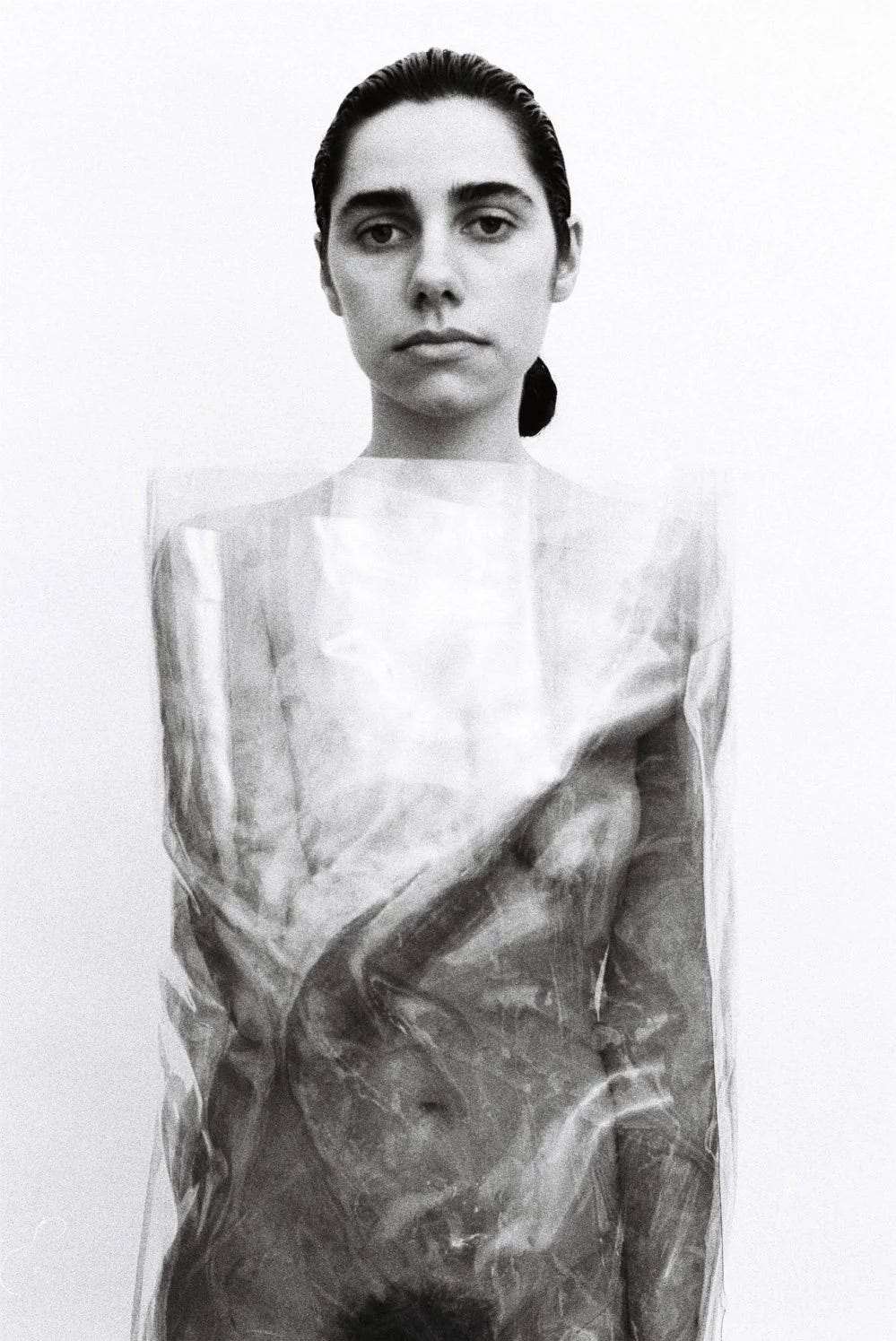
The first thing I find striking about this photo is the contrast of Harvey’s dark, prominent features against a plain white background, Harvey’s expression reflecting bored indifference, detachment. With just one image, she and Mochnacz are acknowledging what the music industry (inclusive of labels, agencies, and the press) often does to artists, especially female artists, which is sexualize them to sell their work. The second thing my eye tracks, of course, is the sheet of plastic wrap in which Harvey is bound, her arms pinioned to her sides. If you’ve bought music, then you’re familiar with the plastic packaging stretched tautly across any record, CD, or cassette. Take, for instance, what you would see unwrapping PJ Harvey Trio’s April 1993 release, Rid of Me, the cover of which features a naked Harvey, right out of the bath, her hair soaked and soaring as she shakes it to dry off.
Context is especially important here: The photo was taken for Harvey’s late-1993 release, 4-Track Demos. At this point, after a couple years of being a “trio” with Ellis and Vaughan, Harvey separated from the band and began to make music as just herself.² 4-Track Demos, though recorded before this turning point, was produced entirely by Harvey herself using the eponymous four-track machine and is an important statement about Harvey’s musical autonomy. Mochnacz’s cover shot for 4-Track Demos is Harvey stripped down to black underwear, a camera hanging around her neck and cat-eye sunglasses obscuring her gaze. Footage of that shoot is included in Mochnacz’s film documenting the Rid of Me tour, Reeling with PJ Harvey (1994). In it, the women stuff dollar bills in Harvey’s bra, an echo of commercialism’s plastic-wrap-residue.
~
Image No. 3: Is This Rock ‘N Roll?
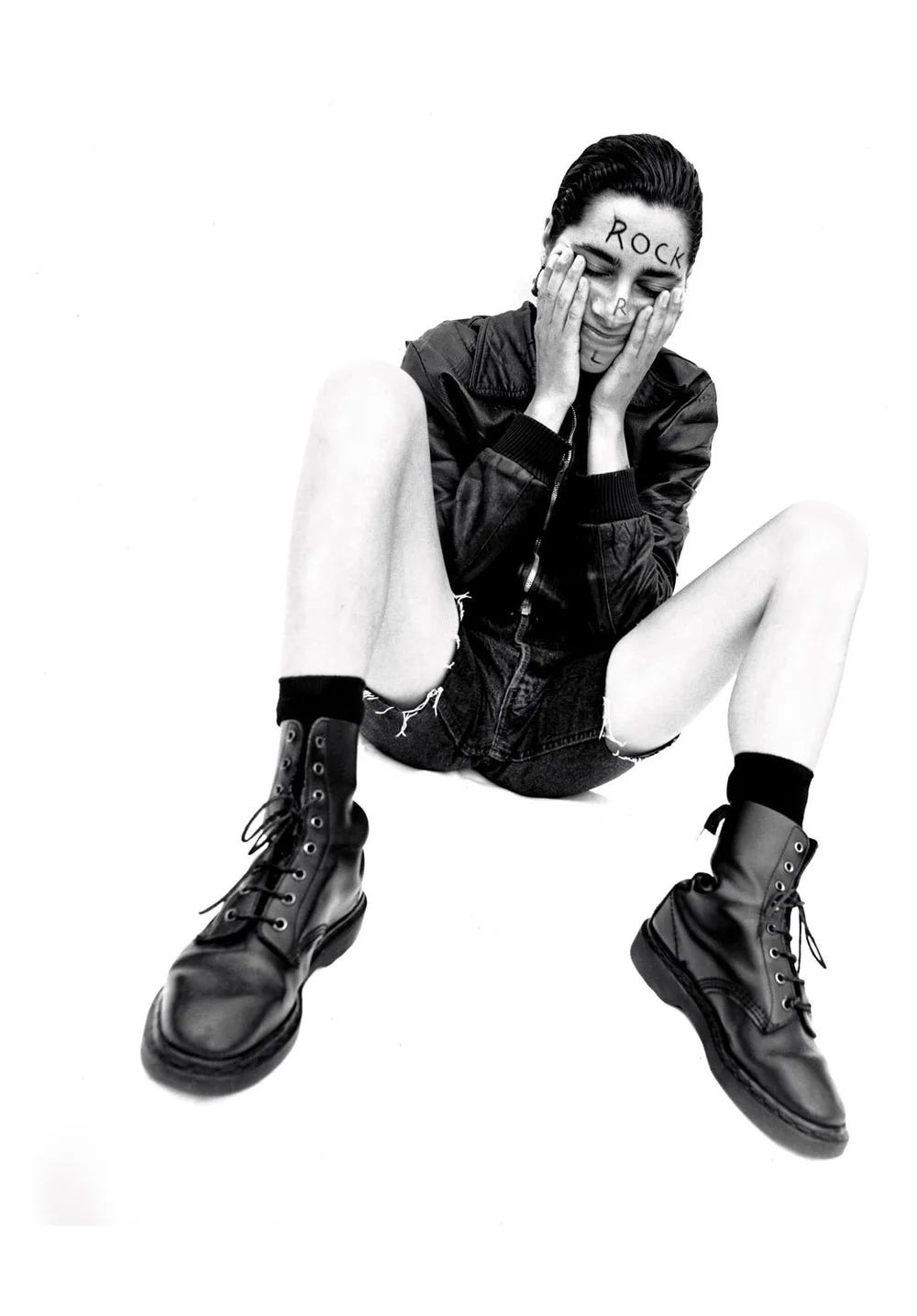
If Harvey was going to be treated like a product by the music industrial complex, then she and Mochnacz figured they could use her as a vehicle for subverting the typical lines of communication between artist and audience. In this image, Mochnacz has scrawled “ROCK ‘N ROLL” across Harvey’s face in black marker; the subject smudges the letters as she wipes the sweat from her face. Mochnacz and Harvey have created here an elegant send-up of industry norms about what rock music is and should be. An exec may be happy sending their clients out to give audiences the impression that they’re “ROCK ‘N ROLL,” but there’s a difference between performing “rock” (as if it’s a reified ideal) and truly embodying it. I don’t know what rock is, but whatever it is, it has something to do with rebellion and, like its blues forebears, reckoning with life’s hardships. Blood sheds and sweat drips off the brow. Indeed, if you listen carefully to many of Harvey’s albums, you can hear the creaking of chairs and handling of instruments. Real labor went into the making of this music.
In another photo from this shoot, “ROCK ‘N ROLL” is swapped for “MARIA MOCHNACZ,” commenting on the scant attention paid to not just the work that goes into making a thing but also its makers. Inevitably, these images of Harvey will be used and reused in the marketing of her music, sometimes without credit, and contribute to listeners’ conception of who PJ Harvey “is.” In that case, why not make attribution a non-negotiable part of accessing and using Harvey’s image? The photo literally shows Harvey endorsing the work of a dear friend and collaborator. It makes sense to me, then, that the “MARIA MOCHNACZ” photo was used as the cover for Harvey’s 2022 release, B-Sides, Demos & Rarities, a collection of musical rough drafts and rejects that reflect the rigor of Harvey’s creative process and the labors that go into it.
~
Image No. 4: This Is Rock ‘n Roll
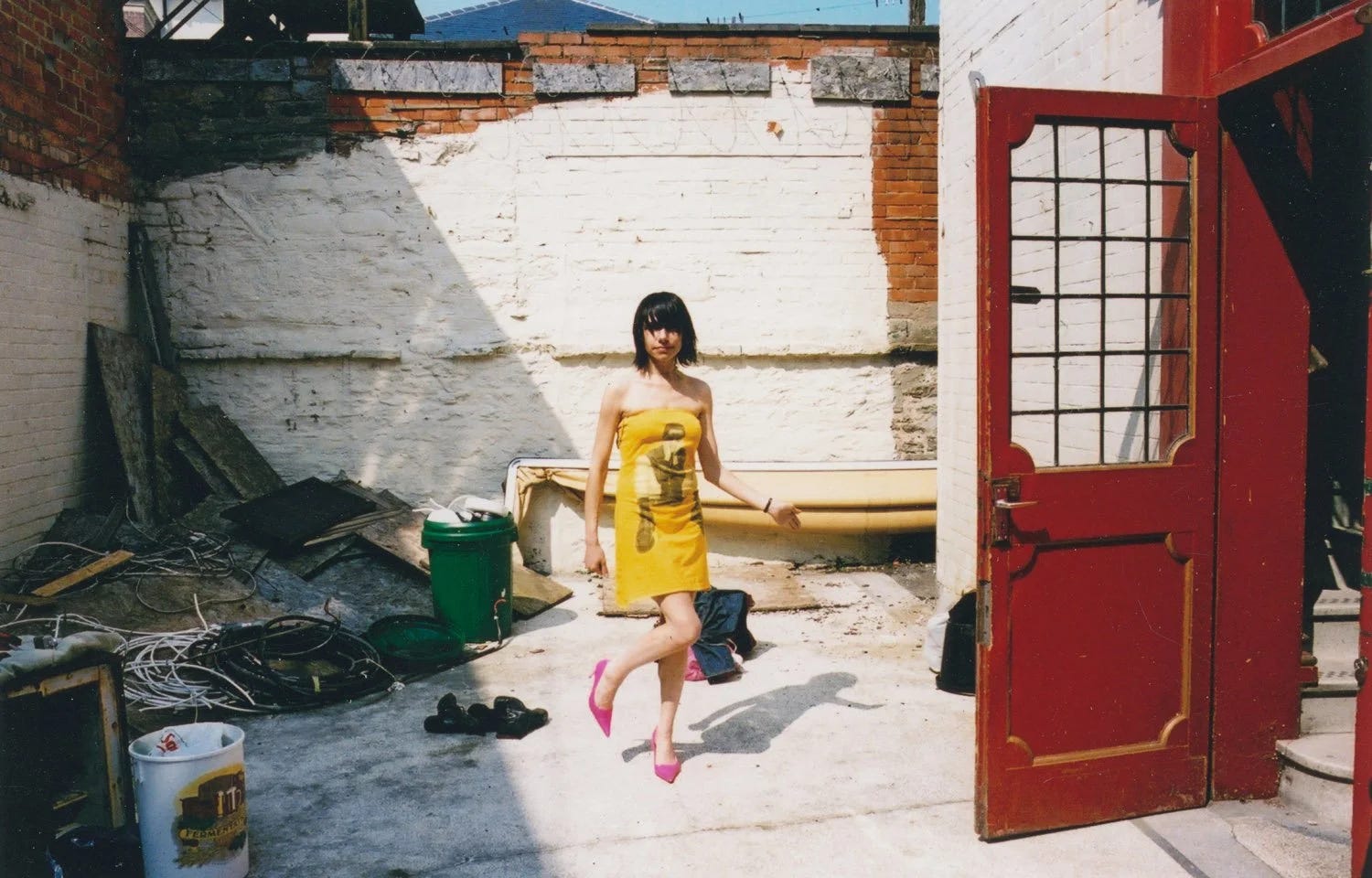
Twelve years or so into her career as “PJ Harvey,” Harvey seems aware her image had become alienated from her true self, insofar as it was used by others to sow speculation or drum up business.³ In 2004, Harvey released Uh Huh Her, an album that feels especially personal and handmade compared to her others. Harvey produced, played every instrument on, and recorded the album (on a four-track home studio), in addition to writing for it some of her most tender and self-exposing lyrics (“I’ll follow you into heaven or hell / and I’ll become as a girl / in the desperate kingdom of love”). Certainly, it was her most intimate and bare since 4-Track Demos, the self-aware photos which she and Mochnacz would innovate upon for Uh Huh Her.
In this image, Mochnacz captures Harvey wearing a dress made out of what appears to be a size XXL T-shirt from Harvey’s own merch table. Notice that Mochnacz is quoting her own work: The photograph of Harvey printed on the shirt is the “ROCK ‘N ROLL” image from 1992. If Mochnacz is quoting her earlier photograph, then Harvey is quoting the various representations of herself which exist. Harvey has always experimented with image and persona (see the pink catsuit from her “Joan Crawford on acid” period in the V&A archives), but what makes the pictured image’s statement so remarkable is that it announces the artist’s exploration of the image-making process. By wearing her own image throughout the promotion of Uh Huh Her, such a personal and immediate work, Harvey is contrasting who we think she is with who she really is.
Mochnacz’s photographs of Harvey make us think deeply, about the woman in the frame—what she might be trying to show us, what we’re actually seeing—and the woman behind the lens. They also, amazingly, achieve both the particular and universal: These are images of Harvey in her bedroom, dressing up, and undressing; these are images of the industry in which Harvey operates, pop culture and fandom writ large, the need for musicians in a capitalist music industry to sell the images of themselves they’ve helped to create. Of course, those images, once commercialized, become detached from the persons they represent. Mochnacz’s are among the few photographs in which PJ Harvey the person may really be glimpsed.
You can see more of Mochnacz’s work on her website.
¹ One of Harvey’s first mediums was sculpture, which she had planned to study at art school before deciding to pursue music full-time.
² Also born of the 4-Track Demos period was Harvey’s performance of “Rid of Me” on The Tonight Show with Jay Leno. According to lore, this was her first appearance after the disbandment of the Trio. Whereas before the song was a three-pronged sneak attack on the listener, in this presentation, a solo Harvey puts herself on wrought display in front of millions on mainstream TV. The point is, and this is getting back to Harvey’s expression of indifference in the photos: She’s not explicitly commenting on what happens to the music after she puts it out into the world; she simply lets the music speak for itself.
³ In 1995, Harvey told NME that “[p]eople think I’m some kind of axe-wielding, bitch cow from Hell who’s angst-ridden and hates all men on the planet, and I think that’s the biggest joke of all. It’s so, so wrong!” Even as early as 1992, when PJ Harvey Trio’s debut Dry was released, Harvey faced daft interviewers who expressed surprise that music of aggression—aggression toward men—could come from a woman. (Harvey’s expression during that interview suggested her exasperation with this tired line of questioning, and rightfully so.)
Cheering about this piece! Thank you for sharing the work and the story behind Maria Mochnacz. The photographs of P. J. Harvey have always been significant to me and my lectures; all those reasons are in my book. The photograph titled Package Her in Plastic passed me by - it's so good. Says EVERYTHING. I love black-and-white photographs, but what I like is the way Mochnacz thinks about the tone and texture of that limited range. On another note, the work, the description of P. J.'s music as a piece of sculpture, is so well put, because she came to London to study sculpture. The way you explained it, she kept that original intent all the time, then, especially when she became a full-time songwriter. PS: Thanks for the mention also - heart thingy.